Last Paris fashion week, designer Willy Chavarria paid tribute to the immigrants and citizens who’ve been detained by ICE across the US. He named the show after his home city, Huron, Ohio, where many families had been affected. His show also drew attention to the imprisonment of over 200 Venezuelan immigrants in a maximum security prison in El Salvador.
In the show’s prelude, 35 models, dressed entirely in white, formed a line, knelt on the ground, clasped their hands behind their backs, and bowed their heads—calling to mind the victims of ICE raids.

Chavarria wanted this show to be about reclaiming identity, especially in a time of cultural erasure. When Hispanic communities feel persecuted, their heritage in America is slowly muted. Chavarria specifically made his show vibrant and colorful to contrast with the white, prison-like outfits in the prelude.
The first model of the show emerged with a bright, minty green suit and bubble-gum pink tie. He wore an angled black top hat with a large white flower on the side, and big-framed sunglasses covered his face. The effect was almost comical and varied greatly from Chavarria’s previous shows, which featured mostly red and black.
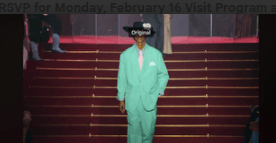
Chavarria explained that the color scheme had been modeled after factory workers’ uniforms; specifically, uniforms from communist or dictatorial countries.
For example, the minty green that was so prominent on his show was actually the same green used in the Soviet Union after the World Wars, because they had mass-produced it for war tanks and weapons, and had a lot left over. They painted everything – from schools, to homes, to uniforms – this same green.
Everything was mass-produced and exactly the same. By using this green, Chavarria turns a symbol of conformity into resistance – color colliding against erasure.
This year’s collection featured much more womenswear than previous years, but all the designs feel masculine, relaying a sense of authority. The silhouettes in particular were sharp and upright. One of these looks had a satin, trench-like coat in a muted olive, a belted, uniformed silhouette, and dark sunglasses.

“I know that fashion can’t change politics,” he said at an awards show last year. “But fashion has more eyes on it than ever before.”
 The Fashion Clause
Leave a comment