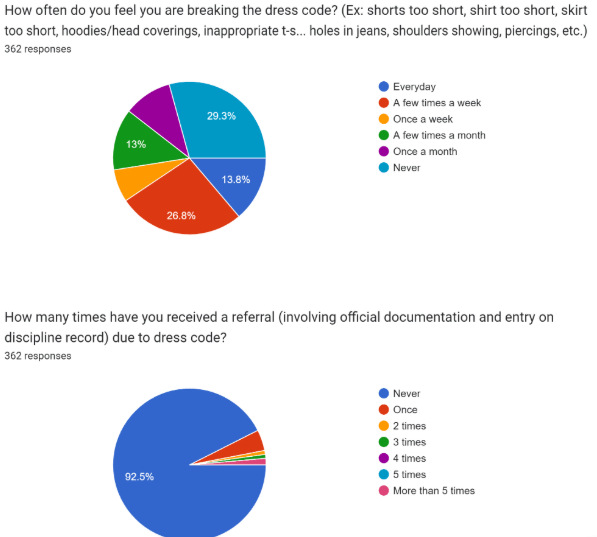
Lola Guzman was a high school student when she noticed that her high school in Louisiana had stricter restrictions on what girls could wear than what guys could, and in the sweltering Southern heat, these rules made a huge difference. Lola began surveying the students at her school, asking questions like their gender, race, and how many times they were caught out of dress code vs how many times they were out of dress code and didn’t get caught. She also reviewed school records of dress code violations. What she found surprised her. It was true that girls were targeted more, but not nearly as much as students of color in general. The school had consistently given out more referrals (which was the punishment for dress code violations. After a certain amount of referrals, grades were dropped and the students had to serve detentions. These held long lasting impacts on the students’ future, and could affect their chances at college.) to students of color. For example, in the 2017-2018 school year, 3.48% of referrals belonged to white males, 5.07% to white females, 38.98% to black males, and 51.03% to black females.
This trend was persistent in all the years she researched. This racial targeting was not just at her school – Lola’s research showed that multiple schools in the area held stricter standards for people of color. For example, durags, which is a protective head covering for black hairstyles, were said to be a violation of the rule that prohibited gang affiliated clothing. According to Lola, students were told their clothing was “gang affiliated”, when really it was just clothing worn more often by black students, such as these durags, or white tank tops. Lola’s research also delved into how school dress codes could often be classist. Schools that require uniforms do not actually provide the uniforms for the students – they have to be purchased at the expense of the parents. She researched a school in New Orleans where, when the parents could not afford the uniform, they had to volunteer four hours at the school for each article of clothing. Obviously low income families did not have the spare time to be volunteering for free, which created an unfair cycle. This type of discrimination is what sparked Lola’s interest in fashion. She saw fashion as a political statement, whether it was something big, or just being able to wear a durag to school. She is still dedicated to sharing her ideologies to the world, and has since switched to painting, where she delves into femininity, and beauty standards.

